
Spoofing Is a Technical Problem. What Follows Is Not.

This piece draws on a recent interview with Eva Sula, an independent defence and digital capability strategist and an advisory board member of Counterspace Europe, conducted for Counterspace Insights.
Eva Sula, an independent defence and digital capability strategist working across NATO, European and allied defence ecosystems, has spent much of her career examining how security capabilities, institutions and systems operate together. Drawing on her experience advising governments and defence organisations and conducting hybrid-warfare tabletop exercises, she identifies a fundamental weakness in European preparedness: “The main challenge is that dependencies are usually not mapped.” In the Baltic, that weakness is becoming increasingly consequential. The question is no longer only whether a signal can be lost, but whether it can be quietly rewritten.
Interference with satellite positioning has become a routine feature of the region’s security environment, affecting shipping and aviation, and putting at risk the civil infrastructure that depends on accurate timing. The difficulty is that the most dangerous forms of interference are not the ones that announce themselves. They are the ones that leave the screen looking exactly as it should. This is what distinguishes spoofing from jamming. Jamming disrupts a signal, typically making the loss or degradation of information noticeable. Spoofing, by contrast, can cause a system to continue displaying information that appears normal while the underlying positioning data is false. The information has not disappeared; the problem is that what is visible may no longer be trustworthy.
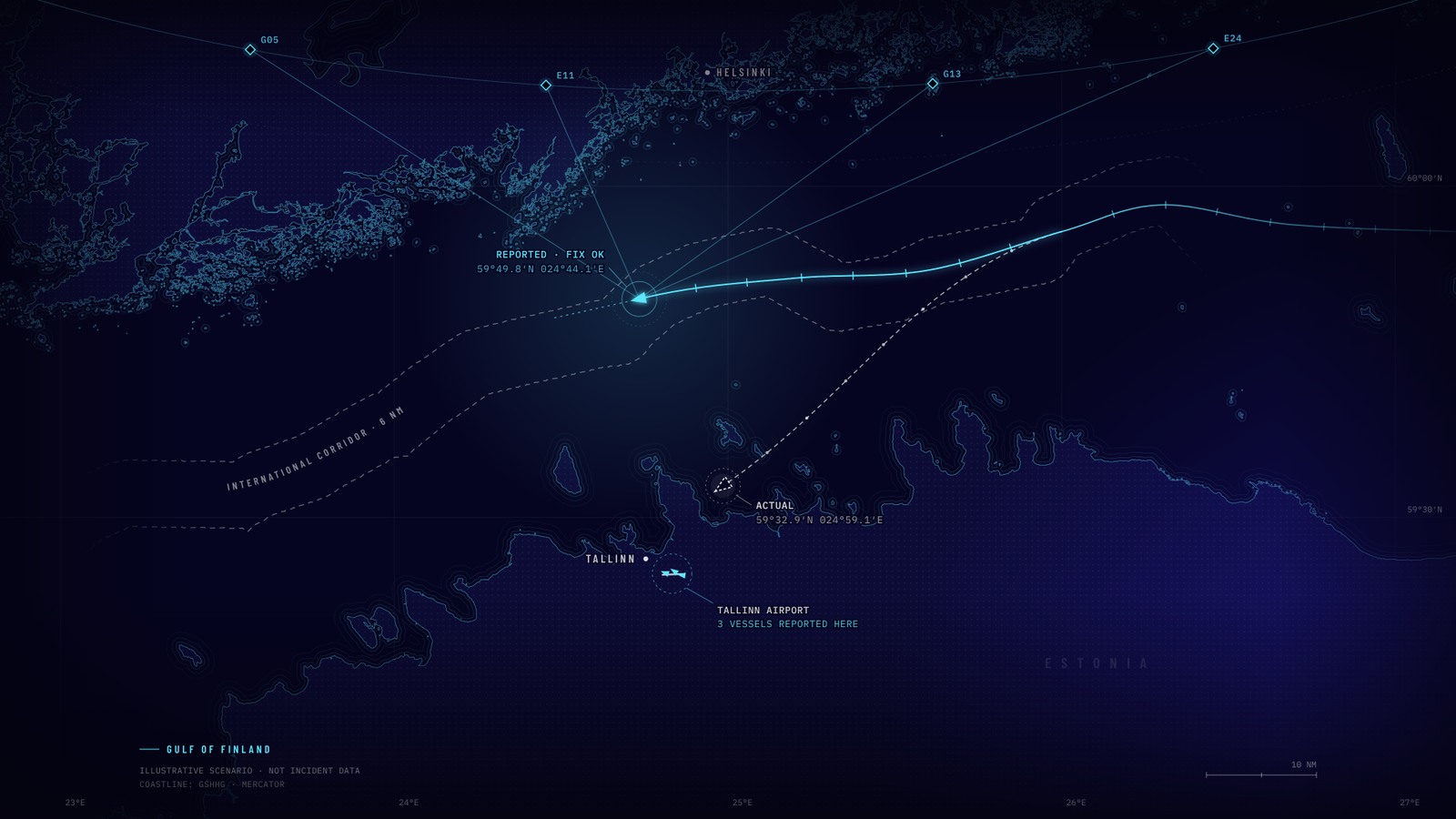
Russia’s shadow fleet has become a growing concern for the EU. The term “shadow fleet” refers to a network of vessels used to circumvent the restrictions the EU imposed on Russian oil from June 2022 onwards, including the crude-oil price cap agreed with the G7 and Australia in December. The Council of the EU has identified the shadow fleet as part of Russia’s efforts to evade sanctions, with vessels using practices that make their ownership, identity, and operations harder to trace. Finland’s Coast Guard has reported tankers falsifying the positions shown for them on tracking systems to hide calls at Russian ports, and Sula points to shadow fleet vessels appearing on those systems as though sitting at Tallinn Airport. A false position like that can come from a ship altering what it broadcasts or from outside spoofing of its satellite receiver, and on screen the two can look alike.
Sula raises another possibility: Russia could use the fleet to install jamming and spoofing systems capable of causing widespread disruption across Western Europe, since compact equipment of this kind can be deployed from maritime platforms. The fleet may therefore be a platform for interference as well as a source of false positions. The public evidence is consistent with that rather than proof of it: researchers at Gdynia Maritime University and GPSPatron concluded that jamming they recorded in 2024 most likely came from a vessel moving through international waters. That was an inference from the signal’s behaviour, not an identified ship.
The Tallinn Airport example shows how much the detection of spoofing can depend on the implausibility of the result. A vessel apparently sitting at an airport gives itself away, because the reported position is physically impossible. Sula’s concern is with the cases that offer no such warning. A vessel may appear to sit at a safe distance while in reality it is at the entrance to a critical shipping lane or port, turning a data problem into a safety risk. The coordinates may be incorrect without being wrong, leaving an operator to confront not an obvious failure but apparently credible information that offers no immediate reason to doubt it. This is what spoofing exposes: when systems appear to be functioning normally, how do we know whether apparently normal information can actually be trusted?
For Sula, the problem does not end once spoofing is identified. A disruption can have cascading consequences across the systems and sectors that depend on the affected service. Who receives information about the incident? Who verifies what has happened? Who responds, and who has the authority to coordinate across sectors as effects spread? The challenge is that responsibility for these downstream consequences is not always clearly mapped across institutions and sectors. This can create overlaps, where multiple actors may assume responsibility for the same task, or gaps, where each assumes that someone else will act. The result is fragmented responsibility that can slow coordination when a timely response matters most.
In the interview, Sula describes hybrid-warfare tabletop exercises she has run in which simulated disruptions begin to cascade across different systems and actors. As those consequences spread, the first reaction, she says, is almost always: “I thought it was you.” The reaction exposes ambiguity in how responsibility is mapped across organisations. Organisational charts and legislation may clarify what an institution is responsible for internally, but they do not necessarily show where those responsibilities intersect with other institutions’ once a disruption crosses sectors or borders. Discovering that ambiguity during an exercise is precisely the point. It allows institutions to identify gaps, overlaps and unclear lines of authority before they are tested in a real spoofing, jamming or wider hybrid incident. An exercise cannot prove that the same breakdown will occur in a real crisis, but it can reveal where coordination may fail under pressure. Those vulnerabilities can then be addressed before an incident reaches a scale at which delayed or confused responses carry wider security consequences.
The technical problem, I would argue, is the smaller half of the challenge. Detecting spoofing achieves little if no one is certain who receives the warning, who confirms it, and who is entitled to act once the effects cross a sectoral or national boundary. Exercises of the kind Sula describes are valuable because they surface that uncertainty cheaply, in a setting where the cost of hesitation is a pause in the room rather than a delay at sea. A gap between institutions has no obvious owner either, which is why exercises can keep finding it without anyone closing it. The task now is to decide who treats those gaps as findings rather than curiosities, and to close them before the Baltic’s interference becomes an emergency.