
Themes
The Event Themes will anchor the event’s content, bringing depth and range to every discussion across the programme.
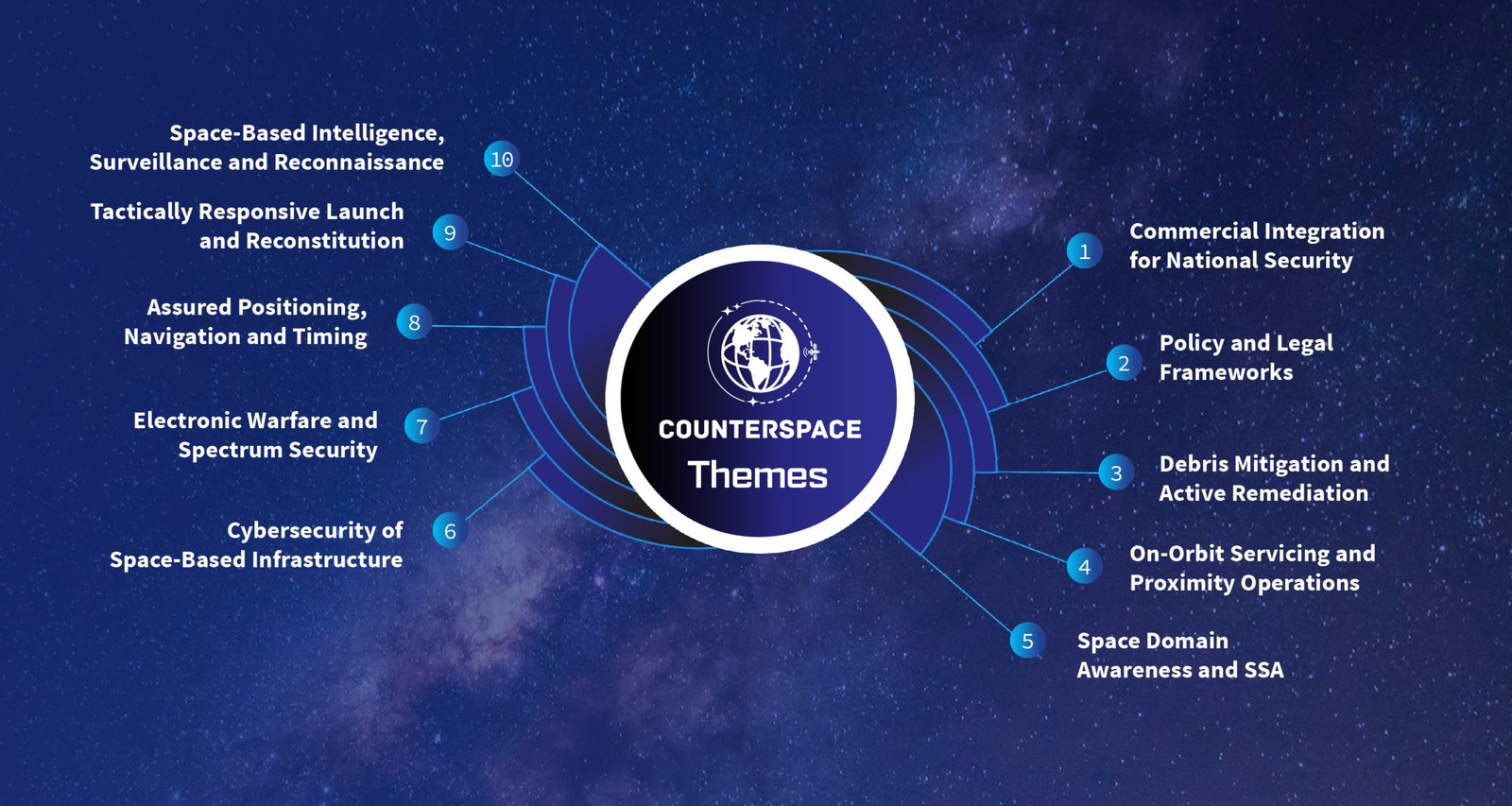
Commercial Integration for National Security
This theme will explore procurement and partnership models, operational tasking of commercial assets, standards for interoperability and data assurance, mechanisms for secure collaboration, and risk-sharing frameworks. It will also cover how to align commercial innovation pipelines with defence priorities, build trusted supply chains, and structure contracts that deliver speed, adaptability and mission assurance in contested environments.
Policy and Legal Frameworks
The development of robust policy and legal frameworks is essential to govern and ensure responsible behaviour in orbit and manage crises involving intentional or accidental interference. This theme will provide a forum to discuss gaps in current treaties, the role of alliances in norm-setting, and how legal tools can keep pace with emerging capabilities.
Debris Mitigation and Active Remediation
The growing volume of orbital debris poses a serious risk to national security, commercial infrastructure and long-term space sustainability. Defence, civil and commercial actors all depend on safe and stable orbital environments, making debris mitigation a strategic, not just technical, priority. This theme will address how governments and industry can share data, responsibilities and resources to reduce debris risk, protect critical space assets and enable sustainable operations in congested orbital regimes.
On-Orbit Servicing and Proximity Operations
Capabilities such as in-orbit refuelling, inspection, relocation and repair increase the lifespan and flexibility of satellites, reduce costs, and enhance resilience. At the same time, these technologies introduce significant dual-use concerns, as the same systems that enable servicing can also be used for surveillance or interference. Establishing trust, transparency and behavioural norms is critical to ensuring their responsible use. This theme will address the strategic implications of dual-use servicing capabilities, the need for coordination in shared orbits, and the development of international guidelines to manage proximity risks and prevent misinterpretation in contested environments.
Space Domain Awareness and SSA
Monitoring objects and behaviours in orbit is essential to detect hostile actions, protect critical assets and establish attribution in times of crisis. The complexity of tracking proliferated constellations and non-cooperative manoeuvres has grown sharply, prompting investments in multi-sensor data fusion, behavioural analytics and cross-domain integration. As the space environment becomes increasingly congested and contested, achieving persistent and credible awareness has become an operational imperative.
Cybersecurity of Space-Based Infrastructure
Threat actors can disrupt services, hijack control systems, exfiltrate data or corrupt mission-critical software. Ensuring the cybersecurity of space infrastructure is essential for operational continuity, trust, and deterrence. This them will address end-to-end cyber risk across satellites, ground segments and user terminals. It will include discussions on secure-by-design architectures, encryption, access control, threat detection and response, supply chain security, vulnerability assessment, and cyber resilience strategies.
Electronic Warfare and Spectrum Security
This theme will explore counter-jamming technologies, resilient waveform design, GNSS spoofing mitigation, spectrum monitoring tools, and electromagnetic interference attribution. It will also cover military-civil spectrum coordination, operational readiness in denied environments, and emerging techniques for safeguarding space-based communications and positioning systems in high-threat scenarios.
Assured Positioning, Navigation and Timing
Space enabled positioning navigation and timing is now a strategic dependency for defence and national security. This theme will examine how PNT services from orbit underpin precision engagement, command and control, joint manoeuvre, and secure synchronisation across land, sea, air, cyber, and space. It will examine how allied forces are responding with assured, resilient and diversified architectures to keep the PNT services available.
Tactically Responsive Launch and Reconstitution
Rapid reconstitution of space assets following attack or failure is now central to deterrence and mission assurance. The emergence of small launch providers, mobile launch platforms and pre-integrated payloads is enabling timelines from decision to orbit in days rather than months. As threats to space infrastructure intensify, the ability to regenerate lost capabilities with tactical speed is no longer optional.
Space-Based Intelligence, Surveillance and Reconnaissance
From high-resolution imaging to signals intelligence and persistent surveillance, ISR from orbit is a cornerstone of modern defence and security. As geopolitical tensions rise and the need for rapid, reliable intelligence grows, space-based ISR systems must be more responsive, integrated and interoperable than ever. From high-resolution imaging to signals intelligence and persistent surveillance, ISR from orbit is a cornerstone of modern defence and security. As geopolitical tensions rise and the need for rapid, reliable intelligence grows, space-based ISR systems must be more responsive, integrated and interoperable than ever.